
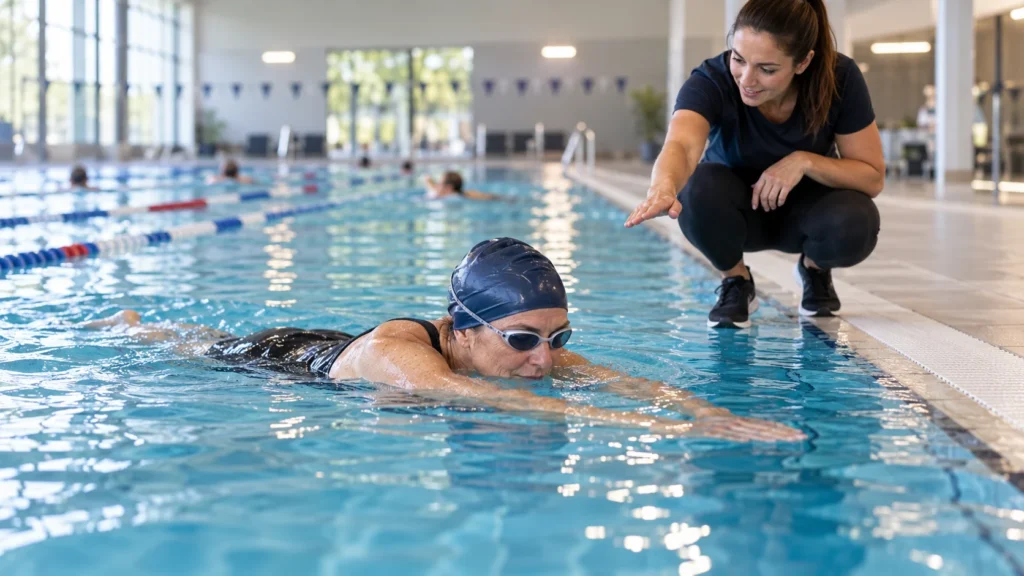
People searching for adult swimming lessons are usually trying to make a practical decision, not collect a list of generic benefits. First decide whether you need instruction, independent lane swimming or a water-based fitness class. Learners should prioritise confidence, qualified teaching and a suitable pool environment; regular swimmers may care more about lane access, pool length and timetable. This guide uses current UK guidance and current M Club information to answer the question behind the search, while keeping fitness advice separate from medical treatment.
Quick answer
For adult swimming lessons, first decide whether you need instruction, independent lane swimming or a water-based fitness class. Learners should prioritise confidence, qualified teaching and a suitable pool environment; regular swimmers may care more about lane access, pool length and timetable.
Adult Swimming Lessons
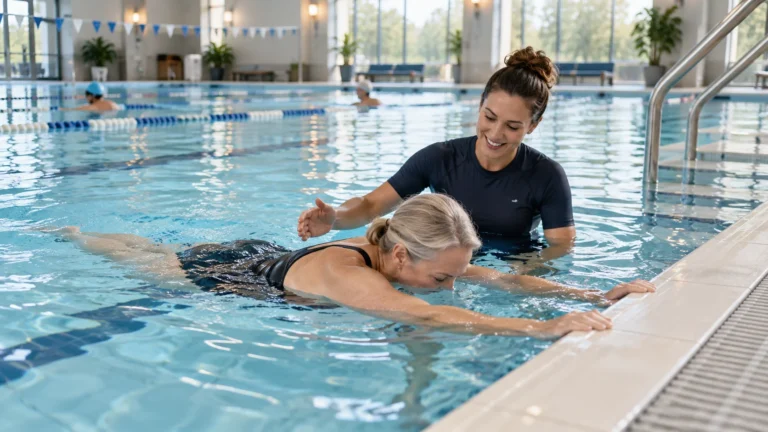
Adult learn-to-swim sessions often start with confidence rather than distance. Breathing into the water, floating, balance, safe entry and exit, propulsion and basic stroke coordination can all come before trying to swim repeated lengths. Swim England’s Adult Swimming Framework is designed for learners from complete beginners through to experienced swimmers who want coaching on technique. M Club’s M Swim offer is described as covering all ages and abilities, so adults should ask which current group or assessment best matches their starting point.
Decide what problem you are solving
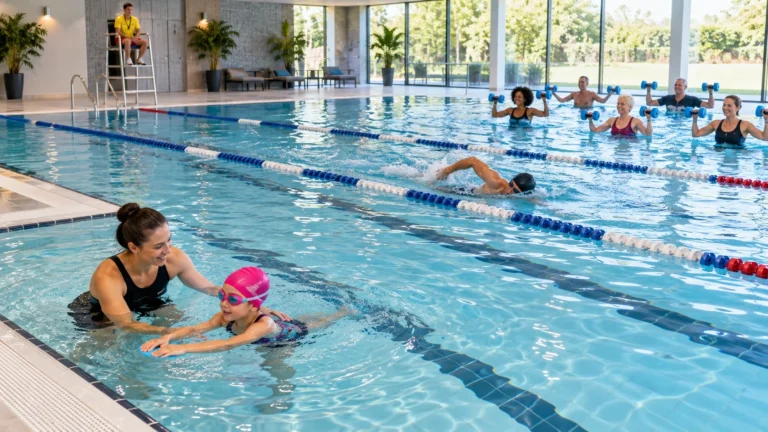
A lesson, a lane-swim session and an aqua class all happen in the pool, but they serve different needs. Lessons teach skills and confidence. Lane swimming lets a competent swimmer practise or train independently. Aqua classes are group exercise in water. Choosing the correct format matters because a nervous non-swimmer needs a very different environment from an experienced swimmer who wants uninterrupted lengths.
Progress is skill-based, not calendar-based
Swimming develops through repeatable skills: comfortable breathing, buoyancy, balance, safe entry and exit, propulsion, timing and stroke coordination. Swim England’s frameworks reflect that progression. Learners often improve unevenly; one person may be relaxed floating but struggle with breathing, while another can move through the water but tires because their technique is inefficient. A good lesson meets the swimmer at that point rather than forcing a fixed timetable.
What to bring and what to ask
Comfortable swimwear, a towel and optional goggles cover most first sessions. Long hair may be easier to manage with a cap. Before enrolling, ask about the teaching group, water depth, assessment process, lesson length, progression method and what happens if a learner is anxious. Parents should also check viewing arrangements and how feedback is provided. Adult learners can ask whether there are beginner-only or confidence-focused sessions.
Swimming can complement other exercise
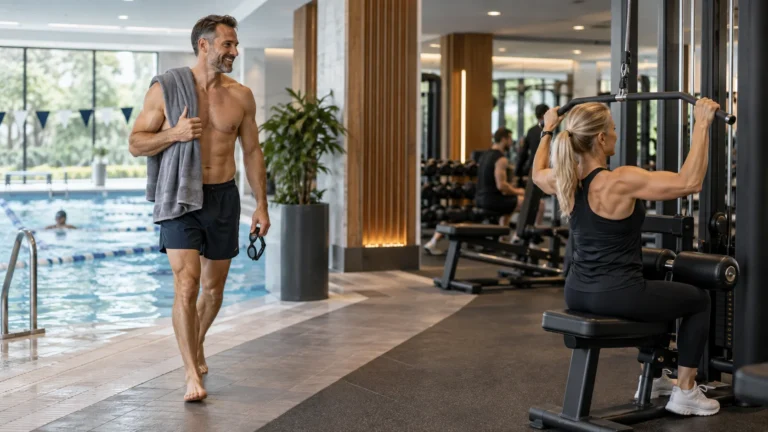
The refreshed UK Chief Medical Officers’ guidance says adults should aim to be active every day, build or maintain strength on at least two days a week and accumulate at least 150 minutes of moderate-intensity activity, or 75 minutes of vigorous activity, or a combination. It also stresses that some activity is better than none and that long periods of sedentary time should be broken up. These are population-level guidelines rather than a personalised prescription. Swimming can contribute to aerobic activity, while strength training provides a different stimulus to muscles and bones. That makes a pool-and-gym membership useful for people who enjoy variety. It does not mean every swimmer needs a complex gym programme; the best combination depends on goals, ability and the amount of activity already being done.
Safety comes before distance
Water confidence is not the same as water competence. Follow pool rules, use lanes appropriate to your speed, do not enter areas beyond your ability and supervise children according to the venue’s policy. Learners should practise skills agreed with their teacher rather than testing deep-water confidence alone. If a medical condition affects exercise or water safety, seek appropriate professional advice before changing activity.
Turn the question into a practical decision
A useful article should end with an action the reader can take without needing to buy anything. That might be checking a timetable, writing down a weekly routine, practising a movement with lighter resistance, asking a swim school about assessment, or comparing what a spa pass includes. Good SEO content earns trust by helping the reader make the next decision clearly; the commercial option should appear only when it genuinely fits that decision.
How M Club fits this question
M Club’s current facilities information describes two Stoke-on-Trent clubs, Hanley and Newcastle. The gym offer includes Pulse Fitness equipment, strength and cardio areas, functional training and TRAKK-connected machines. Both clubs are listed as having swimming pools and fully equipped women-only gym areas. Newcastle is described as having a 25-metre six-lane pool plus a separate learner pool, while Hanley has a 20-metre pool. The facilities page also lists more than 100 classes per week across the clubs, including yoga, Pilates, indoor cycling/spin, pump-style and Les Mills virtual sessions, with the live timetable determining what is actually running on a given day. M Swim is described by M Club as its in-house swim school for all ages and abilities, delivered in temperature-controlled pools by qualified instructors. Exact lesson stages, spaces and booking arrangements, the current M Swim information should be checked before publication.
Learning and fitness are related but different
Swim England’s Learn to Swim material separates confidence, competence, technique and safety. That distinction is useful for fitness planning too: someone can enjoy pool-based activity while still needing instruction for particular strokes or water skills. Likewise, being able to swim a length does not automatically make every pool session suitable for vigorous training. Match the activity to ability, confidence and the pool environment.
Swimming decision checklist
- Choose lessons, lane swimming or aqua based on your actual need.
- Ask about assessment, group size and progression.
- Bring comfortable swimwear, a towel and optional goggles.
- Follow pool rules and lane etiquette.
- Practise only within your current water competence.
- Check which M Club pool and timetable suits the session.
A realistic example
Example: an adult who can move across shallow water but becomes tense when breathing to the side may need technique and confidence work rather than simply more lengths. A parent choosing lessons for a child may care more about learner-pool setup, teacher feedback and progression stages than about the length of the main pool.
Related: our pool and facilities, spa and pool facilities and childcare at the club.
Conclusion
The best answer to adult swimming lessons is the one that helps you choose or act with realistic expectations. Focus on the specific facility, skill or service you need, verify time-sensitive details and keep health claims proportionate. Explore M Club’s current pool and M Swim information, then ask which session or lesson level matches your ability.
FAQs
Do adults need to be able to float before swimming lessons?
No. Water confidence, buoyancy and breathing can be taught as part of beginner lessons.
How quickly will I learn to swim?
Progress varies with confidence, lesson frequency, practice, previous experience and individual learning pace. Focus on skill milestones rather than a fixed number of weeks.
Are swimming lessons only for complete beginners?
No. Adult and child programmes can also support stroke improvement, confidence and more efficient technique.
What is the difference between a learner pool and a main pool?
A learner pool is generally designed to support teaching and confidence work, while a main pool is more likely to be used for lane swimming and general sessions. Exact use varies by venue.
Which We have the learner pool?
M Club’s current facilities page lists a separate learner pool at Newcastle. Hanley is listed with a 20-metre main pool.
Ready to get started?
Join M Club today and access our full range of fitness, spa and wellness facilities across North Staffordshire.
Is Swimming Enough Exercise, or Should You Add Gym Training?
A practical guide to fitness club with swimming pool near me, from confidence and technique to pool choice,…
How to Find Adult Swimming Lessons Near You
A practical guide to swimming lessons for adults near me, from confidence and technique to pool choice, lessons…
Swimming Classes Near Me: Lessons, Lane Swimming or Aqua, Which Do You Need?
A practical guide to swimming classes near me, from confidence and technique to pool choice, lessons and how…